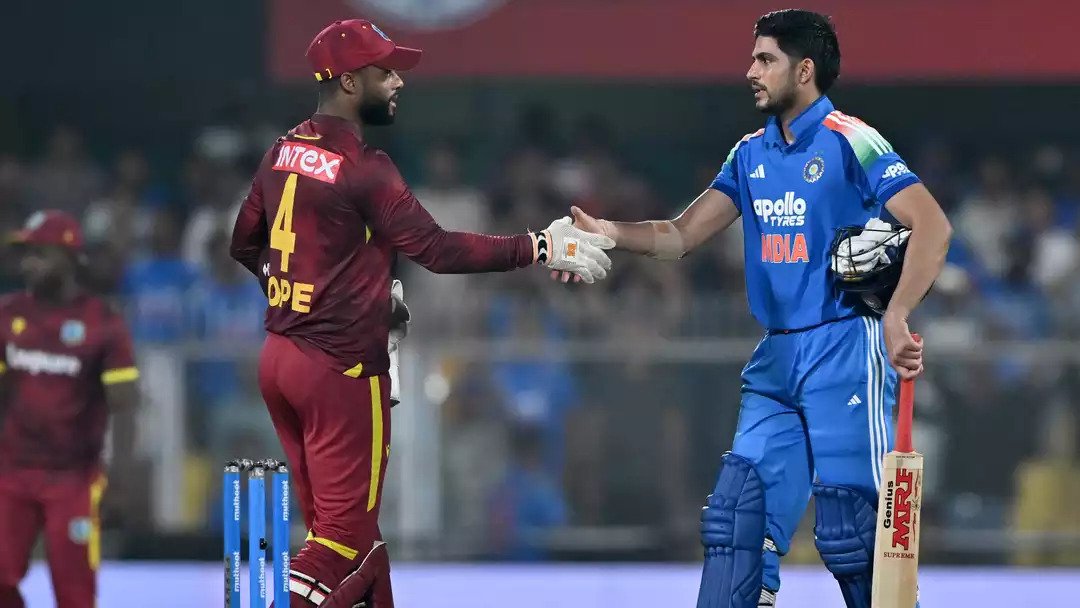
Looking back, both games of the series have very roughly followed the same sequence. Guwahati was the Trivandrum ODI on steroids: on a flatter pitch, West Indies managed to upgrade from 295/7 to 405/7, and both times India chased it down at a canter, without bothering their middle-order. There have been eight centuries, four on either side. Twice now, India’s bowlers have proved insipid in the afternoon heat, and West Indies’s attack erratic under lights.
The differentiator has been Kuldeep Yadav, the leading wicket-taker so far, who used the surface to his advantage in the first ODI, and brought a semblance of control in the other, even if the rest of his ilk has found little to work with. After dealing with him for 20 overs, West Indies would have now built better judgement to face him, but the series is now past them, even if their Powerplay batting and Amir Jangoo have been distinct positives.
When asked about Gudakesh Motie and Vitel Lawes ahead of the first ODI, Shai Hope corrected a journalist for forgetting to mention Roston Chase. The offie has had a largely forgettable series, considering he came in with more India experience than the rest of the spin attack. But finger-spinners on either side have struggled, which prompted West Indies to get in Vitel Lawes, their teenage wrist-spin prodigy, even if it didn’t make much difference in the end.
From Indian fans’ point of view, the series has been a treat: Virat Kohli and Rohit Sharma have cracked tons, while a red-hot Shubman Gill has partied with both, and has a realistic chance of breaking his own aggregate record in a three-match bilateral series. But expect experimentation, not just because India have the series, but because that’s their clear intention with the World Cup in mind.